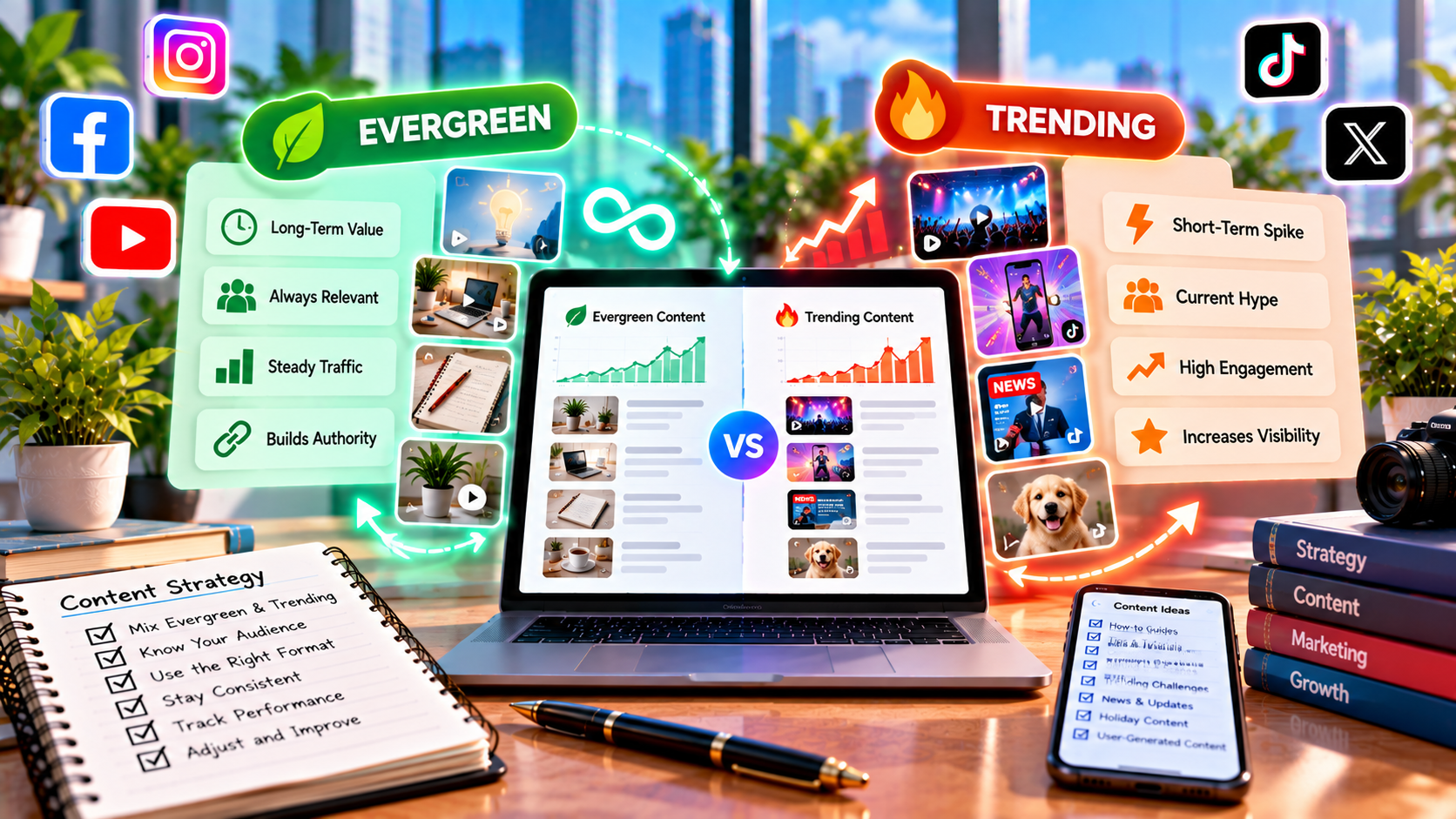
Evergreen vs Trending Social Media Content: What Should You Post?
Social media content does not all have the same lifespan.
Some posts can remain useful for weeks, months, or even years. Others are relevant for only a short period because they are connected to a trend, event, news story, or current conversation.
These two approaches are commonly described as evergreen content and trending content.
Evergreen content provides lasting value, while trending content is designed around timely interest. Both can play a useful role in a social media strategy, but they serve different purposes.
Understanding the difference helps businesses decide what to create, when to publish it, and how to maintain a balanced content mix.
What Is Evergreen Social Media Content?
Evergreen content is content that remains useful and relevant for an extended period.
It does not depend heavily on a particular date, event, or short-lived trend.
Examples include:
How-to guides
Tutorials
Beginner explanations
Checklists
Common mistakes
Frequently asked questions
Definitions
Practical tips
Educational videos
General industry advice
For example:
“How to Calculate Social Media Engagement Rate”
can remain useful long after it is published.
The information may need occasional updating, but the underlying topic does not disappear quickly.
What Is Trending Social Media Content?
Trending content is connected to something currently receiving attention.
It may relate to:
A viral topic
A popular format
A current event
A platform update
A seasonal moment
An industry development
A popular meme or sound
A cultural conversation
A major announcement
Trending content often has a shorter useful lifespan.
For example, a post explaining a newly released social media feature may be highly relevant immediately after the announcement but become less useful once the feature changes or the initial interest disappears.
Evergreen vs Trending Content
The main differences can be summarized as follows:
FactorEvergreen ContentTrending ContentLifespanLongUsually shortTimingFlexibleOften time-sensitiveMain strengthLasting usefulnessCurrent attentionPlanningEasier to plan aheadOften requires quick responseRelevanceStableCan change quicklyExamplesTutorials, guides, FAQsTrends, updates, current topicsRepurposingUsually easierOften limited by timingRiskCan become repetitiveCan become outdated quickly
Neither category is automatically suitable for every post.
The right choice depends on the topic, audience, platform, and purpose.
Why Evergreen Content Matters
Evergreen content creates a stable foundation for a social media account.
Because it remains useful, it can be reused and repurposed over time.
For example, a digital marketing business could create:
“What Is Social Media Engagement?”
Later, that topic could become:
An Instagram carousel
A short educational video
A Facebook post
A blog article
A LinkedIn explanation
A Story quiz
Evergreen topics can therefore provide a reliable source of content ideas.
Benefits of Evergreen Content
Longer Relevance
A useful educational post can continue attracting attention after its original publishing date.
Easier Planning
Because evergreen topics are not highly dependent on current events, they can be planned weeks or months ahead.
Easier Repurposing
A strong evergreen topic can often be presented in several formats.
Useful for New Audiences
People discovering an account later can still benefit from older evergreen content.
Builds Educational Authority
Consistently answering common questions can help establish a brand as a useful source of information within its subject area.
Limitations of Evergreen Content
Evergreen content also has limitations.
It Can Become Repetitive
Publishing similar educational posts repeatedly can make an account feel predictable.
It May Not Create Urgency
Evergreen content usually does not have the immediate attention that comes from a current event or trend.
Some Information Can Become Outdated
Even supposedly evergreen topics may need updates when platforms, technology, or industry practices change.
For example, a guide about social media analytics may remain relevant, but specific interface instructions can change over time.
Why Trending Content Matters
Trending content can help a business participate in conversations that people are already paying attention to.
When used appropriately, it can provide:
Timeliness
Relevance
Conversation opportunities
Increased discoverability
Freshness
Entertainment
For example, if a social media platform introduces a major feature, a marketing business could quickly publish a simple explanation of what changed and what users should know.
The content becomes relevant because the audience is already interested in the subject.
Benefits of Trending Content
Captures Current Interest
Trending subjects already have audience attention.
Adds Freshness
Regularly publishing only evergreen content can make an account feel predictable. Timely posts can add variety.
Creates Conversation Opportunities
Current topics can encourage comments and discussions.
Supports Fast Reactions
A business can demonstrate that it understands relevant developments within its industry.
Can Reach New Audiences
Some trends have broader visibility than an account's usual subjects.
However, exposure is not guaranteed simply because a topic is trending.
Limitations of Trending Content
Short Lifespan
A trend can disappear quickly.
Requires Fast Execution
Waiting too long may mean the audience has already moved on.
Risk of Irrelevance
A trend that does not fit the brand can feel forced.
Accuracy Risks
Current topics can develop quickly, so information should be checked before publishing.
Audience Mismatch
A trend may attract people who are interested in the trend but not in the business.
That means attention does not automatically translate into meaningful results.
When Should You Use Evergreen Content?
Evergreen content is especially useful when the objective is to build a reliable educational library.
It can work well for:
Tutorials
Beginner education
FAQs
Industry basics
Product education
Common problems
Long-term audience development
Search-oriented content
For example, a business that wants to educate new customers can build a collection of evergreen guides covering the most common questions.
When Should You Use Trending Content?
Trending content can be useful when the topic is:
Relevant to the audience
Connected to the brand
Timely
Factually clear
Appropriate for the platform
It can be particularly useful for:
Industry updates
New platform features
Seasonal campaigns
Current conversations
Relevant trends
Major events
The key is relevance.
A business does not need to participate in every trend.
Don't Confuse Trends With Useful Content
A trend can generate attention, but attention alone does not make content valuable.
Before joining a trend, ask:
Is this relevant to the audience?
Does it fit the brand?
Can the business add something useful?
Is the information accurate?
Does it support the content objective?
Will participating feel natural?
If several answers are no, the trend may not be worth using.
How to Balance Evergreen and Trending Content
A balanced content strategy can use evergreen content as the foundation and trending content as a flexible layer.
For example, a monthly plan could include:
Content TypePurposeEvergreen educationLong-term valueEvergreen tipsPractical helpCommunity contentAudience interactionTrending topicTimely relevanceIndustry updateCurrent informationPromotional contentBusiness objective
The exact ratio should not be treated as a universal rule.
A business in a rapidly changing industry may need more timely content, while an educational brand may rely more heavily on evergreen subjects.
Create Evergreen Content First
One practical approach is to build a strong evergreen library before focusing heavily on trends.
Start by answering the questions that will remain relevant.
For example, a social media marketing website might create evergreen content around:
Social media marketing basics
Engagement rate
Reach and impressions
Content strategy
Content calendars
Social media KPIs
Analytics
Content planning
Audience research
Once that foundation exists, timely topics can be added around relevant developments.
Turn Trending Topics Into Evergreen Content
A useful technique is to take a current topic and extract a lesson that remains useful after the trend disappears.
For example:
Trending topic: A social media platform introduces a new video feature.
A short-term post might explain:
“What This New Feature Does.”
An evergreen follow-up could be:
“How Short-Form Video Features Can Affect Content Strategy.”
The first post addresses the immediate event. The second focuses on a broader concept.
This allows one current event to generate both timely and long-lasting content.
Use Trends as Content Starters
A trend does not always need to become the entire post.
Instead, use it as an opening to discuss a broader subject.
For example:
Trend: A popular discussion about declining social media reach.
Possible evergreen angle:
“Why Social Media Reach Can Change and What Businesses Should Measure.”
The trend creates the entry point, while the content provides lasting information.
Refresh Evergreen Content Regularly
Evergreen does not mean “publish once and forget forever.”
Review older content periodically.
Check:
Are the facts still correct?
Are platform features still available?
Are examples outdated?
Are screenshots still accurate?
Are statistics still relevant?
Has industry terminology changed?
If necessary, update the content and republish or reference the improved version.
This is especially important for social media because platforms frequently change features and interfaces.
Build a Content Library
Businesses can organize evergreen content into a library.
For example:
Beginner Library
Social media basics
Engagement definitions
Platform terminology
Strategy Library
Content strategy
Content planning
Audience research
Analytics Library
Reach
Impressions
Engagement rate
KPIs
ROI
Advanced Library
Performance analysis
Content testing
Reporting
Attribution
A library makes it easier to find older content that can be updated or repurposed.
Use Trending Content Carefully for Brand Building
Trends can increase visibility, but a brand should not become dependent on them.
If an account constantly posts unrelated viral topics, audiences may struggle to understand what the brand actually represents.
For example, a social media marketing company can use relevant platform trends while still maintaining its core subjects:
Social media education
Marketing
Content creation
Analytics
Growth
The trend should support the brand rather than replace it.
Evergreen and Trending Content on Different Platforms
The balance may also vary by platform.
Evergreen carousels, educational Reels, and relevant trends can work together.
TikTok
Timely formats and trends may be particularly useful, while educational videos can provide longer-term value.
Educational posts, community discussions, timely updates, and evergreen resources can all have a role.
Evergreen professional insights can be combined with relevant industry developments and current discussions.
The same subject may therefore need a different treatment depending on where it is published.
Measure Evergreen and Trending Content Differently
A trending post may receive strong attention quickly, while an evergreen post may produce useful results over a longer period.
This means they should not always be judged using exactly the same timeframe.
For trending content, examine:
Initial reach
Early engagement
Shares
Comments
Short-term traffic
For evergreen content, examine:
Continued reach
Saves
Shares
Profile visits
Website traffic
Long-term engagement
Repeated usefulness
The measurement should match the expected lifespan of the content.
Don't Judge Content Only by Reach
A trending post may receive a large amount of reach without producing meaningful business results.
An evergreen guide might receive less initial attention but generate:
Saves
Website visits
Leads
Returning visitors
Useful conversations
This is why content performance should be evaluated according to the original objective.
A business focused on awareness may value reach. A business focused on leads may care more about qualified traffic and conversions.
Common Evergreen Content Mistakes
Never Updating Old Content
Information that was once evergreen can become outdated.
Repeating the Same Topics
Long-term content does not mean publishing identical explanations repeatedly.
Making Content Too General
Evergreen content still needs a specific audience and useful purpose.
Ignoring Current Developments
A brand that publishes only timeless content may miss important changes in its industry.
Common Trending Content Mistakes
Joining Every Trend
Not every popular topic belongs on every account.
Being Too Late
A trend may lose relevance before the content is published.
Sacrificing Accuracy
Speed should not replace fact-checking.
Losing Brand Identity
Unrelated trends can attract attention while weakening the account's overall positioning.
Focusing Only on Virality
A viral moment is not automatically a successful marketing result.
A Practical Evergreen and Trending Workflow
A simple process can be:
Research → Classify → Create → Publish → Measure → Refresh
Step 1: Research
Collect audience questions, industry topics, and current developments.
Step 2: Classify
Decide whether each idea is evergreen, trending, or a combination of both.
Step 3: Create
Develop the appropriate format and message.
Step 4: Publish
Schedule evergreen content and respond quickly when genuinely relevant trends appear.
Step 5: Measure
Review performance according to the content's purpose and lifespan.
Step 6: Refresh
Update useful evergreen content when information changes.
Example for a Social Media Marketing Brand
Imagine a social media marketing brand planning one month of content.
Its evergreen topics might include:
How engagement rate works
How to read Instagram analytics
Common social media mistakes
How to create better content
How to measure social media ROI
Its trending topics might include:
A relevant platform update
A new creator feature
A current industry discussion
A timely social media trend
The evergreen topics provide the educational foundation.
The trending topics keep the account connected to current conversations.
Together, they create a more flexible content system.
How SMM Panels Can Fit Into This Content Approach
Businesses that use SMM panels can still maintain an educational-first content strategy.
Content can explain subjects such as:
Social media growth
Engagement
Content planning
Analytics
Audience development
Social media services
Growth expectations
An SMM panel can be part of a broader marketing workflow, but it should not become the entire content strategy.
A strong social presence still depends on relevant content, consistent communication, audience understanding, and performance measurement.
Frequently Asked Questions
Is evergreen content better than trending content?
They serve different purposes. Evergreen content is designed for lasting usefulness, while trending content focuses on current attention and relevance.
How long does evergreen content last?
There is no fixed lifespan. Some topics can remain useful for years, while others require updates when technology, platforms, or industry practices change.
How quickly should trending content be published?
Trending content generally benefits from timely execution, but speed should not come at the expense of accuracy or relevance.
Should every business follow social media trends?
No. Businesses should consider whether a trend is relevant to their audience, brand, and content objectives.
Can a trending topic become evergreen content?
Yes. A current event can often be used as a starting point for a broader educational topic that remains useful after the event is no longer trending.
How should evergreen content be updated?
Review facts, examples, platform features, statistics, screenshots, and recommendations. Update anything that has become inaccurate or outdated.
How much evergreen content should a business publish?
There is no universal percentage. The right balance depends on the industry, audience, platform, resources, and content objectives.
Final Thoughts
Evergreen and trending content serve different roles in social media marketing.
Evergreen content provides stability and long-term value. Trending content provides timeliness and helps a brand participate in relevant current conversations.
The strongest approach is usually not choosing one and ignoring the other. Instead, businesses can build a reliable library of evergreen content and use relevant trends selectively when they genuinely fit the audience and brand.
A simple rule is:
Build with evergreen content. Stay relevant with timely content. Measure both according to their purpose.
That balance can make a social media account more useful, flexible, and sustainable over time.