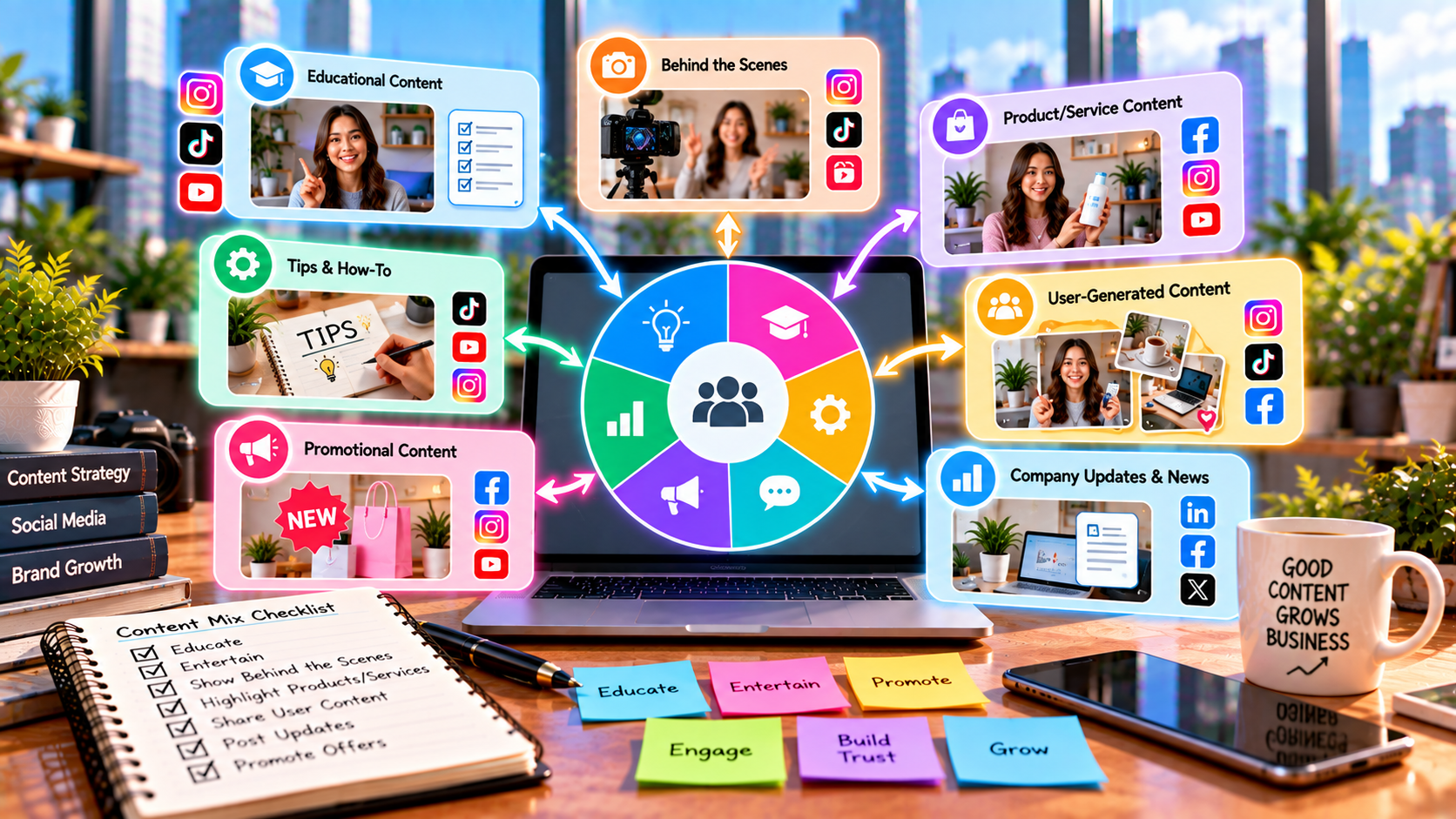
How to Create a Social Media Content Mix for a Business
A business does not need to post about the same thing every day to stay active on social media. In fact, repeating the same type of content can make a social media page feel predictable and overly promotional.
A better approach is to create a balanced social media content mix.
A content mix is the combination of different types of content a business publishes to achieve different goals. Some posts may educate the audience, some may encourage conversation, others may showcase products, and some may strengthen the relationship between the brand and its audience.
The right mix depends on the business, audience, platform, resources, and marketing objectives. There is no universal percentage that every company needs to follow.
The important principle is simple:
Give your audience different reasons to follow, engage with, trust, and eventually buy from the business.
What Is a Social Media Content Mix?
A social media content mix is the planned combination of content categories, formats, topics, and purposes used across a business's social media channels.
For example, an online business might publish:
Educational posts
Product demonstrations
Customer stories
Behind-the-scenes content
Promotional offers
FAQs
Industry insights
Short videos
Community questions
Tips and tutorials
These different content types work together rather than competing with each other.
A business that only posts product promotions may struggle to maintain audience interest. A business that only publishes educational content may build awareness without clearly communicating what it sells.
A balanced mix helps connect attention, value, relationship-building, and conversion.
Why Does a Content Mix Matter?
Social media users have different interests and intentions.
One person may want to learn something. Another may be comparing products. Someone else may simply want entertaining or relatable content.
A varied content mix gives the audience multiple ways to interact with the brand.
It Reduces Repetition
Posting the same format and message repeatedly can make a page feel repetitive.
Different content categories keep the publishing experience more varied.
It Supports Different Marketing Goals
One post may generate awareness while another generates website traffic or sales.
A content mix allows businesses to work toward several objectives instead of expecting every post to accomplish everything.
It Builds Trust
Educational content, demonstrations, customer experiences, and transparent business communication can help people understand a brand before they make a purchase.
It Creates More Opportunities for Engagement
Questions, polls, opinions, tutorials, and relatable content can encourage different forms of interaction.
It Supports the Customer Journey
People do not always move directly from discovering a brand to buying something.
Content can support different stages of the journey.
The Main Types of Business Social Media Content
A useful starting point is to divide content into several broad categories.
These categories can be adjusted depending on the business.
1. Educational Content
Educational content teaches the audience something useful.
Examples include:
Tutorials
How-to guides
Industry explanations
Checklists
Tips
Mistake-based posts
Frequently asked questions
Definitions
Step-by-step instructions
For a digital marketing company, an educational post might explain how engagement rate is calculated.
For a clothing business, it could explain how to choose the right size.
For a software company, it could demonstrate how to complete a common task.
Educational content is especially useful for building expertise and attracting people who are actively looking for information.
2. Product or Service Content
Businesses also need to explain what they actually offer.
This content can include:
Product features
Service explanations
Demonstrations
Use cases
Benefits
New products
Product comparisons
Frequently asked questions
Pricing-related information where appropriate
The goal is not simply to say "Buy now."
Instead, show how the product or service can solve a relevant problem.
For example:
Weak approach:
Our software has powerful analytics. Buy today.
More useful approach:
Managing five social media accounts? Here are the three reports that can help you see which platforms are actually driving traffic.
The second approach provides context before presenting the product.
3. Promotional Content
Promotional content directly supports sales or conversions.
Examples include:
Limited-time offers
Discounts
New product announcements
Service packages
Seasonal campaigns
Special deals
Free trials
Product launches
Promotional content has a place in a business's content mix, but a page does not necessarily need to make every post promotional.
The appropriate amount depends on the business model, audience expectations, campaign objectives, and platform.
4. Engagement Content
Engagement-focused content encourages people to participate in a conversation or interaction.
Examples include:
Questions
Polls
This-or-that posts
Opinions
Quizzes
Community discussions
"Which would you choose?" posts
Industry debates
Audience challenges
For example:
Which social media metric do you check first: reach, engagement, or conversions?
This type of post can generate useful audience feedback while also helping a business understand what its followers care about.
5. Social Proof Content
Social proof helps potential customers understand how other people experience the business.
Examples include:
Customer testimonials
Reviews
Case studies
User-generated content
Before-and-after examples where appropriate
Customer success stories
Product ratings
Client results
Social proof should be presented accurately and transparently. Businesses should avoid exaggerating results or presenting exceptional outcomes as guaranteed results.
6. Behind-the-Scenes Content
Behind-the-scenes content shows the people and processes behind the brand.
Examples include:
Team introductions
Product creation
Office activities
Packaging
Development processes
Planning sessions
Company milestones
Day-in-the-life content
This can make a business feel more human and give audiences additional context about how the company operates.
7. Brand Story Content
Brand-focused content explains who the business is and what it stands for.
It can include:
Company history
Mission
Values
Founder story
Milestones
Lessons learned
Business journey
Community involvement
These posts can help audiences understand the identity behind the products or services.
8. Entertaining or Relatable Content
Not every post needs to teach or sell.
Businesses can sometimes use:
Humor
Relatable situations
Industry jokes
Memes
Light storytelling
Cultural moments
Fun observations
The content should still make sense for the brand and its audience.
Entertainment works best when it feels relevant rather than forced.
9. Industry or Trend Content
Businesses can also comment on relevant developments within their industry.
This may include:
New technology
Platform changes
Industry news
Emerging practices
New consumer behavior
Important research
Relevant trends
The goal should be to add useful context rather than simply following every trend.
A Simple Content Mix Framework
There is no fixed formula that works for every company, but businesses can start by organizing content around different purposes.
For example:
Content TypeMain PurposeEducationalTeach and attractEngagementEncourage interactionProduct/ServiceExplain the offerSocial ProofBuild confidencePromotionalDrive conversionsBehind the ScenesHumanize the brandBrand StoryBuild identityIndustry ContentDemonstrate relevanceEntertainmentIncrease connection
The business can then adjust the balance based on its goals and performance data.
Should You Follow the 80/20 Rule?
The 80/20 rule is sometimes used in social media marketing to suggest that most content should provide value while a smaller portion should directly promote products or services.
It can be a useful starting concept, but it should not be treated as a universal requirement.
A business selling through social media may need more product-focused content than an educational media brand.
Likewise, a new product launch may temporarily require more promotional communication.
Instead of following a fixed ratio blindly, ask:
What does the audience need, and what does the business need to accomplish?
That question is more useful than forcing every account into the same percentage.
Match Content to the Customer Journey
Different people may be at different stages when they encounter a business.
A simple customer journey might look like:
Discovery → Interest → Evaluation → Purchase → Retention
Content can support each stage.
Customer StageSuitable ContentDiscoveryEducational, entertaining, industry contentInterestTutorials, problem-solving content, brand storiesEvaluationProduct information, comparisons, case studiesPurchaseOffers, product details, FAQsRetentionSupport content, tips, customer stories, community content
This does not mean every post needs to target only one stage. However, thinking about the journey can prevent a content strategy from becoming heavily focused on one objective.
Create Content Pillars Within Your Mix
Content categories explain why a post exists.
Content pillars explain what subjects the business regularly talks about.
For example, an SMM business might use these pillars:
Social media education
Platform-specific tips
Analytics
Content strategy
Marketing tools
Business growth
SMM services
The content mix can then operate inside these pillars.
For example:
Educational + Instagram Analytics
How to understand Instagram reach.
Engagement + Content Strategy
What is the biggest content planning challenge for your business?
Product + SMM Services
How the SMMZY dashboard works.
This creates structure without making every post look the same.
Combine Content Types With Different Formats
Content type and content format are different.
A business might have educational content in several formats:
Carousel
Short video
Long-form video
Text post
Infographic
Story
Article
For example:
PurposePossible FormatsEducationCarousel, video, articleEngagementPoll, question, discussionProductDemo, image, videoSocial proofTestimonial, case studyPromotionGraphic, video, offer postBehind the scenesStory, Reel, photoBrand storyVideo, text, photo
This gives businesses much more flexibility.
Do Not Confuse Variety With Randomness
A varied content mix should still feel like one brand.
Imagine a company posts:
A serious industry report on Monday
A product promotion on Tuesday
A random meme on Wednesday
A motivational quote on Thursday
A completely unrelated trend on Friday
That is variety, but it may not create a clear brand identity.
A better content mix connects different topics through a consistent:
Audience
Brand voice
Visual identity
Subject area
Business purpose
The content can be varied without becoming disconnected.
How to Build a Content Mix Step by Step
Step 1: Define the Business Goal
Start with what the business wants to accomplish.
Possible goals include:
Brand awareness
Engagement
Website traffic
Lead generation
Sales
Customer retention
Community growth
Step 2: Understand the Audience
Identify:
Problems
Questions
Interests
Buying concerns
Content preferences
Knowledge level
Step 3: Choose Core Content Categories
Select the types of content that support the business and audience.
Step 4: Select Content Pillars
Choose several recurring subjects that fit the brand.
Step 5: Add Different Formats
Decide whether each category will use videos, carousels, images, text posts, Stories, articles, or other formats.
Step 6: Create a Practical Balance
Make sure the content mix is realistic for the available team, budget, and production capacity.
Step 7: Measure Performance
Review how each category performs.
Step 8: Adjust the Mix
Increase useful categories and reduce content that consistently fails to support the intended objective.
Example Content Mix for an SMM Business
Consider a fictional social media marketing business targeting small companies and creators.
Its content categories could look like this:
CategoryExample TopicPurposeEducationHow engagement rate worksTeachPlatform TipsInstagram profile optimizationHelpAnalyticsMetrics businesses should trackEducateEngagementAsk followers about their biggest challengeInteractCase StudyCampaign workflow exampleDemonstrateProductDashboard feature explanationExplainPromotionService announcementConvertBehind the ScenesTeam/workflow contentHumanizeIndustrySocial media developmentStay relevant
This creates a page that does more than advertise services.
How Often Should Each Content Type Be Posted?
There is no universal schedule.
Posting frequency depends on:
Platform
Audience
Business type
Team size
Content quality
Production resources
Marketing goals
A small business may publish three strong posts each week, while a media company may publish several pieces every day.
Consistency matters more than forcing a publishing volume that the business cannot maintain.
Instead of asking:
"How many posts should we publish?"
Also ask:
"How many quality posts can we consistently produce?"
Review Your Content Mix Monthly
A content mix should not remain unchanged forever.
At the end of each month, review:
Which categories received the most meaningful engagement?
Which formats generated the most reach?
Which posts generated website visits?
Which content generated leads or sales?
Which topics received questions?
Which posts were ignored?
Which content took too much effort for too little return?
For example, if educational carousels consistently generate saves while generic promotional graphics receive little interaction, the business may decide to produce more educational material while improving how promotional content is presented.
The objective is not to eliminate underperforming content immediately. Instead, look for patterns over time.
Use a Content Mix Matrix
A simple matrix can help teams plan different types of content.
AwarenessEngagementConversionEducational✓✓Product✓✓Social Proof✓✓✓Promotional✓Behind the Scenes✓✓Brand Story✓✓Industry Content✓✓
This makes it easier to see whether the content plan is heavily concentrated in one area.
Avoid Making Every Post Serve Every Goal
A common mistake is trying to make every post:
Get views
Gain followers
Generate comments
Drive website traffic
Produce sales
Build trust
One post can support several objectives, but it does not need to accomplish everything.
A tutorial may primarily aim to educate.
A product demonstration may primarily support consideration.
A promotional post may primarily support conversion.
Clear objectives make performance easier to interpret.
Common Content Mix Mistakes
Posting Only Promotional Content
A feed filled with sales messages can become difficult for audiences to engage with.
Posting Only Educational Content
Useful information is valuable, but businesses also need to communicate their products or services.
Following a Fixed Ratio Without Context
A 70/30 or 80/20 rule may be useful as a starting point, but it should not replace actual audience and business data.
Using Too Many Content Categories
Adding ten or fifteen categories can make content production unnecessarily complicated.
Ignoring Content Formats
Two posts with the same subject can perform differently because of their format.
Forgetting the Business Goal
Content should support a broader marketing purpose.
Chasing Trends
Not every trend fits every brand.
Failing to Review Performance
A content mix should evolve based on evidence.
Confusing Activity With Progress
Publishing more posts does not automatically mean better marketing.
A Simple Weekly Content Mix Example
A small business could start with a simple weekly structure:
Monday — Educational
Teach one useful concept.
Tuesday — Product or Service
Explain how the business solves a specific problem.
Wednesday — Engagement
Ask a useful question or start a discussion.
Thursday — Social Proof
Share a customer story, review, or case study.
Friday — Educational or Industry
Share another useful insight.
Weekend — Optional Brand or Behind-the-Scenes Content
Show the human side of the business.
This is only an example. The actual schedule should be adapted to the business and platform.
How SMM Panels Fit Into a Business Content Mix
An SMM panel should not replace the content itself.
A business still needs useful ideas, quality content, audience understanding, and measurement.
For businesses or agencies using SMMZY, social media services can be considered one supporting part of a wider marketing workflow.
A broader process could look like:
Content Planning → Content Creation → Publishing → Audience Engagement → Performance Tracking → Marketing Support → Optimization
The content mix remains important because sustainable social media activity depends on what the audience actually sees and finds useful.
A Practical Content Mix Checklist
Before publishing your monthly content plan, ask:
Does the content support a clear business goal?
Are we providing useful information?
Are we explaining our products or services clearly?
Are we giving people reasons to interact?
Are we using more than one format?
Are we showing real customer experiences where appropriate?
Does the content sound like the same brand?
Are we speaking to the right audience?
Are we leaving enough room for timely content?
Are we measuring results?
Are we willing to adjust the mix?
If the answer is yes to most of these questions, the content mix has a useful foundation.
Frequently Asked Questions
What should a business post on social media?
A business can combine educational, product, promotional, engagement, social proof, behind-the-scenes, brand, industry, and entertaining content. The right combination depends on its audience and objectives.
Is there a perfect social media content ratio?
No. Ratios such as 80/20 can be useful planning frameworks, but there is no universal percentage that works for every business.
How many types of content should a business use?
There is no fixed number. A small business can begin with three to five core categories and expand when its resources and audience needs justify it.
Should businesses post promotional content?
Yes, promotional content can be an important part of a business social media strategy. It should be balanced with content that provides information, demonstrates value, and builds relationships.
Can one post be educational and promotional?
Yes. For example, a tutorial can teach the audience while naturally showing how a company's product or service solves the problem.
How do I know whether my content mix is working?
Look at the metrics connected to your goals. Depending on the objective, this may include reach, engagement, saves, shares, website traffic, leads, conversions, or revenue.
Should every platform have the same content mix?
Not necessarily. The overall brand message can remain consistent while the specific content mix and formats are adapted to each platform.
Final Thoughts
A strong social media presence is not built by publishing the same type of post repeatedly.
Businesses need a combination of content that educates, informs, engages, builds trust, communicates products or services, and supports business objectives.
The most useful content mix is not necessarily the one with the most categories. It is the one that a business can produce consistently while providing real value to the audience.
A practical framework is:
Business Goals → Audience Needs → Content Categories → Content Pillars → Formats → Publishing → Measurement → Adjustment
Start with a manageable mix, observe what happens, and improve it over time.
Social media content should not simply fill a calendar. Each category should have a reason to exist.