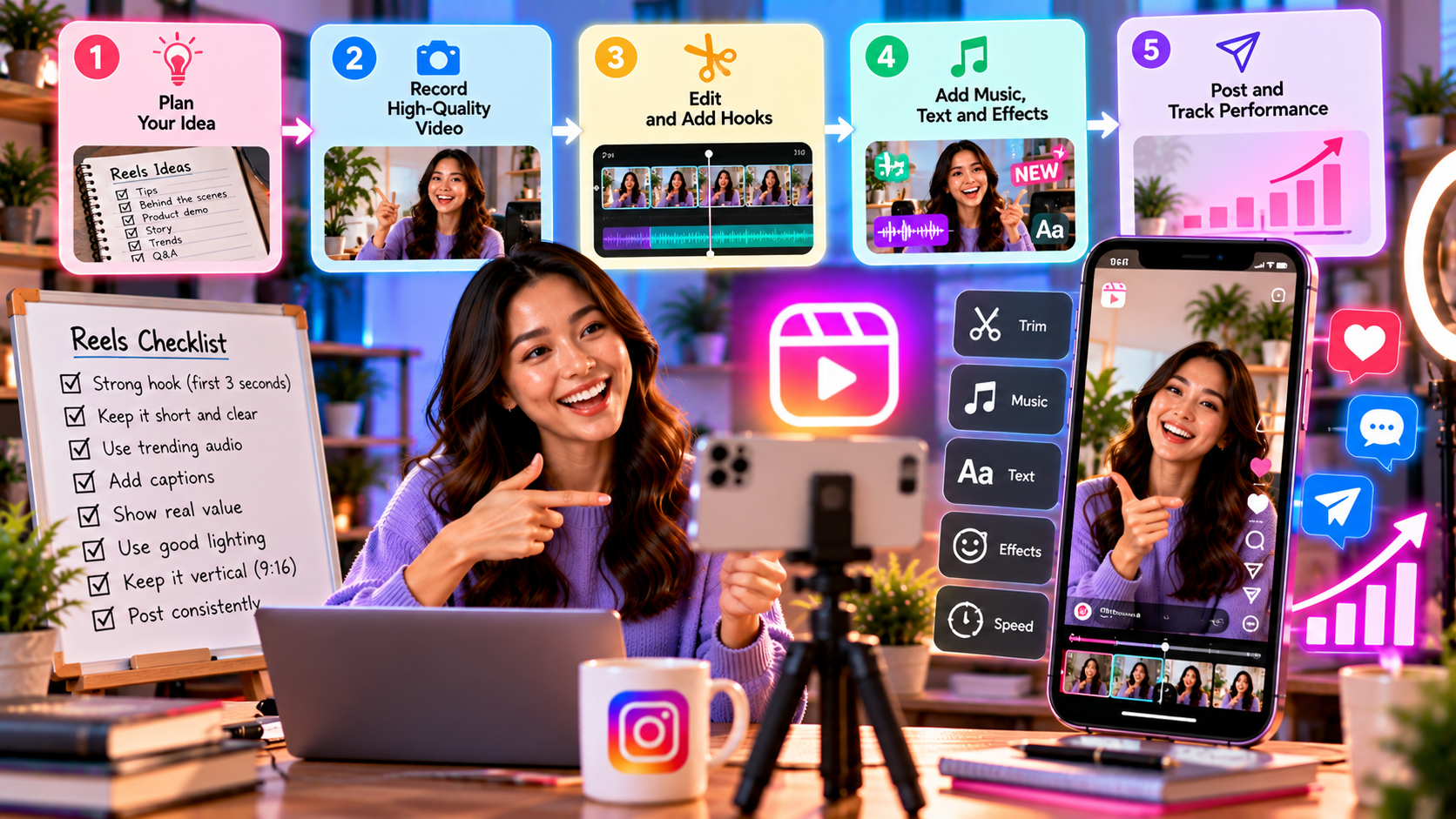
How to Create Better Instagram Reels
Instagram Reels have become an important format for creators, brands, and businesses that want to communicate ideas through short-form video.
But creating a Reel is more than recording a video, adding music, and publishing it.
A good Reel needs a clear idea, a strong opening, useful or entertaining content, good pacing, readable visuals, and a reason for the viewer to keep watching.
The goal is not to make every Reel go viral.
The goal is to create videos that are easy to understand, relevant to the intended audience, and strong enough to earn attention.
This guide explains how to create better Instagram Reels from the initial idea to publishing and performance analysis.
What Makes an Instagram Reel Good?
There is no single formula that guarantees a successful Reel.
However, strong Reels commonly have several characteristics:
A clear topic
A defined audience
A strong opening
Good visual quality
Easy-to-follow structure
Useful, entertaining, or interesting information
Appropriate pacing
Clear audio or captions
A natural ending
A relevant call to action
The most important question is:
Why should someone continue watching this video?
If that question has a clear answer, the Reel has a stronger foundation.
Start With One Clear Idea
One of the biggest mistakes is trying to cover too much information in one short video.
For example:
"Everything You Need to Know About Instagram Marketing"
is too broad for one short Reel.
Instead, break the subject into smaller ideas:
3 Instagram bio mistakes
How to write a better Reel hook
One way to improve profile conversion
How to create a weekly content plan
Why some posts receive more saves
Each Reel then has one clear purpose.
A useful formula is:
One Reel = One Main Idea
This makes the video easier to create and easier for viewers to understand.
Define the Audience Before Recording
A Reel should be created for someone, not simply for everyone.
Ask:
Who is this video for?
What problem do they have?
What do they already know?
What do they want to learn?
What would make them stop scrolling?
For example, instead of:
"Instagram marketing tips"
create:
"Instagram tips for small businesses with less than 5,000 followers."
The second idea gives you a much clearer audience.
Create a Strong Reel Hook
The opening is one of the most important parts of a short video.
A hook gives the viewer a reason to continue.
Problem-Based Hook
"Your Instagram bio may be losing potential followers."
Mistake-Based Hook
"Stop making these three mistakes when creating Reels."
Curiosity Hook
"Most small businesses overlook this part of their Instagram profile."
Result-Based Hook
"Here's a simple way to make your next Reel easier to understand."
Question Hook
"Why do some Reels get watched while others are skipped immediately?"
The hook should match the actual content.
A dramatic opening followed by weak information may get initial attention but does not create a strong viewer experience.
Avoid Long Introductions
Short-form content does not usually need a long introduction.
Instead of:
"Hi everyone, welcome to my page. I hope you are doing well. Today I'm going to discuss something that many people have been asking me about..."
Get to the point.
For example:
"If your Reels are getting views but very few followers, check these three things."
The viewer immediately knows what the video is about.
Build a Simple Reel Structure
A simple structure can make recording much easier.
Hook
Get attention.
Context
Explain the problem or situation.
Value
Provide the information, demonstration, story, or entertainment.
Takeaway
Give the viewer the main lesson.
CTA
Tell them what to do next if a CTA is useful.
The structure can be simplified as:
Hook → Value → Takeaway → CTA
Not every Reel needs all five stages.
For an entertainment Reel, for example, the structure may be completely different.
Write a Short Script
You do not need a complicated script.
A short outline is often enough.
For example:
Topic: Instagram bio mistakes
Hook: "Your Instagram bio has three seconds to explain what you do."
Point 1: Make your audience clear.
Point 2: Explain your value.
Point 3: Give visitors a reason to follow.
CTA: "Save this before updating your bio."
This gives the creator a structure without making the video sound overly rehearsed.
Keep the Visuals Clear
Good video quality does not necessarily require expensive equipment.
Start with the basics:
Clean background
Good lighting
Stable camera
Clear subject
Appropriate framing
Readable text
Good audio
A smartphone can be enough to create professional-looking content when the environment is well controlled.
Use Vertical Video
Reels are designed for a vertical viewing experience.
A common format is:
9:16
This allows the video to use the available mobile screen effectively.
Keep important text and visual information away from areas where Instagram's interface elements may cover it.
Improve Your Lighting
Lighting can dramatically change how a Reel looks.
If possible:
Face a light source
Avoid strong backlighting
Use natural window light
Keep the subject evenly illuminated
Avoid extremely dark environments
The objective is simple:
Make the subject easy to see.
Improve Audio
Viewers can tolerate average video quality more easily than difficult-to-understand audio.
Record in a relatively quiet environment.
Avoid:
Loud fans
Traffic noise
Echo-heavy rooms
Multiple people talking
Strong background noise
If the content depends on speech, clear audio should be a priority.
Add Captions When Appropriate
Captions can make spoken content easier to follow.
They can also help people understand the video when they are not listening to the audio.
Keep captions:
Large enough to read
Short enough to follow
Properly synchronized
Positioned where Instagram's interface will not hide them
Do not cover the main visual subject with unnecessary text.
Use On-Screen Text Strategically
Text can quickly communicate the topic.
For example:
"3 Instagram mistakes hurting your profile"
can tell viewers what they are about to learn.
But adding large amounts of text to every frame can make the video difficult to watch.
Use text to support the message, not replace it.
Pay Attention to Pacing
A Reel can contain excellent information and still feel slow.
Pacing refers to how quickly the content moves from one idea to another.
You can improve pacing by:
Removing unnecessary pauses
Cutting repeated sentences
Changing visuals when the idea changes
Using B-roll
Moving directly between points
Removing unnecessary introductions
Fast does not automatically mean better.
The right pacing depends on the subject.
A detailed tutorial may need slower explanations, while a quick tip can move much faster.
Use Visual Changes to Maintain Attention
A talking-head video does not have to show exactly the same frame for its entire duration.
You can introduce:
B-roll
Screenshots
Product demonstrations
Text overlays
Screen recordings
Different camera angles
Before-and-after examples
The visual should support what the speaker is saying.
Avoid adding random effects simply because they look interesting.
Tell a Story When the Topic Allows It
Not every Reel needs to be a tutorial.
Stories can be powerful because people naturally want to know what happens next.
A simple structure is:
Situation → Problem → Attempt → Result → Lesson
For example:
"We changed one part of our content strategy for 30 days. Here's what happened."
That creates a natural reason to continue watching.
Use Examples Instead of Only Giving Advice
Generic advice is easy to ignore.
Examples make information more concrete.
Instead of:
"Write better hooks."
Show:
Before:
"Today we're going to discuss Instagram."
After:
"Your first sentence could be the reason people keep scrolling."
Then explain why the second version is clearer.
Examples turn abstract advice into something viewers can immediately understand.
Create Save-Worthy Reels
Some Reels are designed for entertainment.
Others can become useful references.
Examples include:
Checklists
Tutorials
Step-by-step guides
Content ideas
Mistake lists
Templates
Short educational frameworks
Tool explanations
A Reel can naturally encourage saving when it contains information viewers may want to use later.
A relevant CTA might be:
"Save this checklist for your next content planning session."
The CTA works because it matches the purpose of the content.
Create Share-Worthy Reels
People may share content because it is:
Useful
Funny
Relatable
Educational
Surprising
Inspiring
Relevant to a friend or colleague
Instead of simply asking viewers to share, create something worth sharing.
For example:
"Send this to the person who keeps posting without a content plan."
can work when the content genuinely addresses a common situation.
Use Trends Carefully
Trending sounds, formats, and concepts can provide creative opportunities.
But following every trend can make an account feel inconsistent.
Before using a trend, ask:
Does this trend make sense for my audience?
If the answer is no, skip it.
A smaller relevant trend can be more useful for a brand than a huge trend that has nothing to do with its audience.
Add Your Own Perspective
A trend becomes more valuable when you contribute something original.
For example, instead of copying a popular Reel:
Trend → Your experience → Your example → Your conclusion
This allows the format to provide attention while your perspective provides the actual value.
Make Your Reels Recognizable
A consistent visual identity can help people recognize your content.
You can maintain consistency through:
Similar typography
Brand colors
Recurring visual elements
Consistent editing style
Repeated series
Similar tone
Recognizable opening patterns
Consistency does not mean every Reel should look identical.
The goal is to create a recognizable identity.
Create Repeatable Reel Series
A series can make content planning easier.
For example:
Instagram Mistake Monday
Every Monday, explain one common Instagram mistake.
Or:
60-Second Marketing Tips
Each Reel provides one practical marketing lesson.
Series formats provide several benefits:
Easier planning
Consistent expectations
More topic ideas
Stronger content identity
Easier performance comparison
Choose the Right Reel Length
There is no single ideal length for every Reel.
The appropriate length depends on the subject.
A simple tip may need only a short explanation.
A tutorial may require more time.
Instead of forcing every video into the same duration, ask:
How much time does this idea actually need?
Then remove anything that does not contribute to the message.
Shorter is not automatically better.
Longer is not automatically better.
Useful is better.
Use the First Frame Carefully
The first frame can function like a thumbnail or visual introduction.
It should help communicate:
What the Reel is about
Why the viewer should care
What type of content they are about to watch
For example:
"5 Instagram Bio Mistakes"
is clearer than:
"You Need to See This!"
The first tells the viewer exactly what to expect.
Write Better Reel Captions
The video should carry the main message, but the caption can add context.
A useful caption can:
Explain an additional detail
Provide a resource
Summarize the lesson
Add an example
Encourage discussion
Provide a relevant CTA
Do not write a long caption simply to make the post appear more complete.
Use Relevant Keywords Naturally
Instagram search and discovery make clear topic communication useful.
Use relevant terms naturally in:
Spoken words
On-screen text
Captions
Profile information
Content topics
For example, if the Reel teaches Instagram content strategy, make that subject clear rather than using vague wording.
Do not fill captions with repeated keywords.
Write for people first.
Hashtags Should Support the Topic
Hashtags can provide additional context, but they should not become the entire discovery strategy.
Use relevant hashtags when they make sense for the content.
Avoid:
Huge blocks of unrelated hashtags
Repeating the same list on every post
Using popular hashtags that have nothing to do with the topic
A small set of relevant context can be more useful than a large collection of random terms.
Create Reels Around Audience Questions
One of the easiest ways to find Reel ideas is to listen to your audience.
Look at:
Comments
Direct messages
Customer questions
Support conversations
Search suggestions
Frequently asked questions
If five people ask the same question, you already have a content idea.
For example:
Question: "How often should I post on Instagram?"
Possible Reel:
"How Often Should a Small Business Post on Instagram?"
Then answer the question directly.
Repurpose Existing Content Into Reels
You do not have to create every idea from scratch.
A blog post, carousel, webinar, podcast, or long-form video can become multiple Reels.
For example:
One article:
"10 Instagram Profile Mistakes"
can become:
One Reel about profile photo mistakes
One Reel about bio mistakes
One Reel about CTA mistakes
One Reel about link mistakes
One Reel summarizing the full checklist
This creates more content from one research effort.
Create Different Hooks for the Same Idea
One useful way to improve your Reel strategy is to test different ways of presenting the same topic.
Topic:
Instagram profile optimization
Hook A:
"Your Instagram bio may be costing you followers."
Hook B:
"Before you post another Reel, fix these three profile problems."
Hook C:
"Someone visited your Instagram profile. Here's what they should understand immediately."
The core idea is similar, but the entry point changes.
This helps you discover which audience problems and angles attract stronger attention.
Review Your Reel Performance
After publishing, do not judge a Reel only by views.
Depending on the analytics available to your account, examine:
Reach
Views
Watch time
Average watch behavior
Likes
Comments
Shares
Saves
Profile visits
Follows
Website actions where applicable
The important question is:
What did viewers do after seeing the Reel?
For example:
ReelReachSharesSavesProfile VisitsA8,0004085120B6,00075150210C12,000305590
Reel C reached the largest audience.
But Reel B generated more shares, saves, and profile visits relative to its reach.
That gives you a useful clue about the type of content your audience may find more valuable.
Don't Chase Views Alone
A Reel with 100,000 views may look impressive.
But ask:
Did relevant people watch?
Did they follow?
Did they visit the profile?
Did they share it?
Did they save it?
Did it support the business objective?
A Reel with 10,000 highly relevant views can sometimes be more useful to a niche business than a Reel with 100,000 views from an unrelated audience.
The objective determines how performance should be interpreted.
Test One Variable at a Time
If you want to understand what improves Reel performance, avoid changing everything simultaneously.
For example, test:
Week 1: Different hooks
Week 2: Different visual openings
Week 3: Different topics
Week 4: Different CTA styles
This makes the results easier to interpret.
If you change the topic, editing style, posting time, length, and CTA at the same time, it becomes difficult to know what caused the difference.
Common Instagram Reel Mistakes
1. Starting Too Slowly
The video takes too long to reach the main point.
2. Covering Too Many Ideas
The viewer cannot identify the main message.
3. Using Clickbait
The hook promises something the video does not deliver.
4. Poor Audio
Viewers struggle to understand the speaker.
5. Too Much Text
The screen becomes difficult to follow.
6. Copying Viral Content
The account adds little original value.
7. Using Trends Without Relevance
The trend does not fit the audience or brand.
8. Making Every Reel Promotional
The audience receives advertisements instead of useful content.
9. Ignoring the Ending
The Reel simply stops without completing the idea.
10. Obsessing Over One Viral Video
A single successful Reel does not define a sustainable content strategy.
A Simple Instagram Reel Creation Workflow
Use this process for your next video:
1. Choose a topic
Select one specific idea.
↓
2. Define the audience
Decide who should care.
↓
3. Write the hook
Give them a reason to continue.
↓
4. Outline the value
List the key points.
↓
5. Record
Focus on clear delivery and good audio.
↓
6. Edit
Remove unnecessary pauses and repetition.
↓
7. Add supporting visuals
Use text, B-roll, screenshots, or demonstrations when useful.
↓
8. Review
Ask whether the Reel is clear without additional explanation.
↓
9. Publish
Use an appropriate caption and relevant context.
↓
10. Measure
Review performance and identify what to test next.
A Practical Reel Template
Here is a simple structure that works for many educational Reels:
Hook:
"Your Instagram Reels may be losing viewers for one simple reason."
Problem:
"The video takes too long to explain what it is about."
Solution:
"Start with the problem, result, or question instead."
Example:
Instead of saying, "Today we're going to discuss Instagram growth," say, "Here are three reasons your Instagram growth has slowed down."
CTA:
"Save this before recording your next Reel."
This structure is simple, but it can be adapted to many subjects.
A 30-Day Instagram Reel Improvement Plan
Week 1: Study Your Existing Reels
Identify:
Best-performing videos
Lowest-performing videos
Strongest hooks
Most common topics
Most shared content
Most saved content
Week 2: Test Hooks
Create several Reels around similar topics with different opening approaches.
Week 3: Test Formats
Try:
Talking head
Screen recording
Tutorial
List format
Storytelling
Demonstration
Week 4: Analyze
Look for patterns.
Ask:
Which topics attracted the right audience?
Which hooks held attention?
Which videos generated shares?
Which generated saves?
Which generated profile visits?
Which generated followers?
Then use the findings to plan the next month.
Can SMM Panels Help With Instagram Reels?
SMM panels can provide services related to Instagram views, likes, followers, and other social media metrics.
However, these services should not be confused with creating better content.
A higher visible number does not automatically mean that a Reel is more useful to the target audience or that Instagram will recommend it more broadly.
For long-term growth, the foundation should remain:
Good ideas + strong presentation + audience relevance + consistent testing
SMMZY can support social media campaigns with marketing services, but those services should complement rather than replace a genuine Instagram content strategy.
Frequently Asked Questions
How long should an Instagram Reel be?
There is no single ideal duration for every Reel. The appropriate length depends on the idea and how much explanation it requires. Keep the video long enough to deliver the value without unnecessary filler.
How do I make my Reels more interesting?
Start with a clear hook, focus on one idea, use strong visuals, maintain appropriate pacing, and provide useful or entertaining information.
Should every Reel have a hook?
For educational, promotional, and informational Reels, a clear opening is usually helpful. The hook can be a problem, question, result, statement, or visual—not necessarily a dramatic sentence.
Should I use trending audio?
Trending audio can be useful when it fits the content and audience. It should not be used simply because it is popular.
Why do my Reels get views but no followers?
The Reel may attract attention without clearly communicating why viewers should follow the account. Check whether the profile, content theme, and CTA give viewers a clear reason to continue following.
Should I post Reels every day?
Not necessarily. A sustainable schedule is generally more practical than forcing daily videos that reduce content quality.
How many hashtags should I use on a Reel?
There is no universal number that guarantees better performance. Use relevant hashtags when they add useful context and avoid unrelated hashtag stuffing.
Why did one Reel perform much better than another?
Differences can come from topic, audience interest, opening, content quality, viewer behavior, timing, competition, or distribution. Compare several videos before deciding what caused the difference.
Can a small account create successful Reels?
Yes. Reels can be discovered by people who do not already follow an account. However, there is no guarantee that a particular Reel will receive large distribution.
Final Thoughts
Creating better Instagram Reels is less about finding a secret formula and more about improving the complete viewing experience.
Start with a clear idea.
Know who the Reel is for.
Create a strong opening.
Deliver useful or entertaining information.
Use clear visuals and audio.
Keep the pacing appropriate.
Give viewers a natural reason to save, share, follow, or take another action.
Then study the results.
The strongest Reel strategy is not:
Create → Hope → Repeat
It is:
Research → Create → Publish → Measure → Learn → Improve → Repeat
When every Reel becomes an opportunity to learn more about your audience, your content strategy becomes stronger over time.