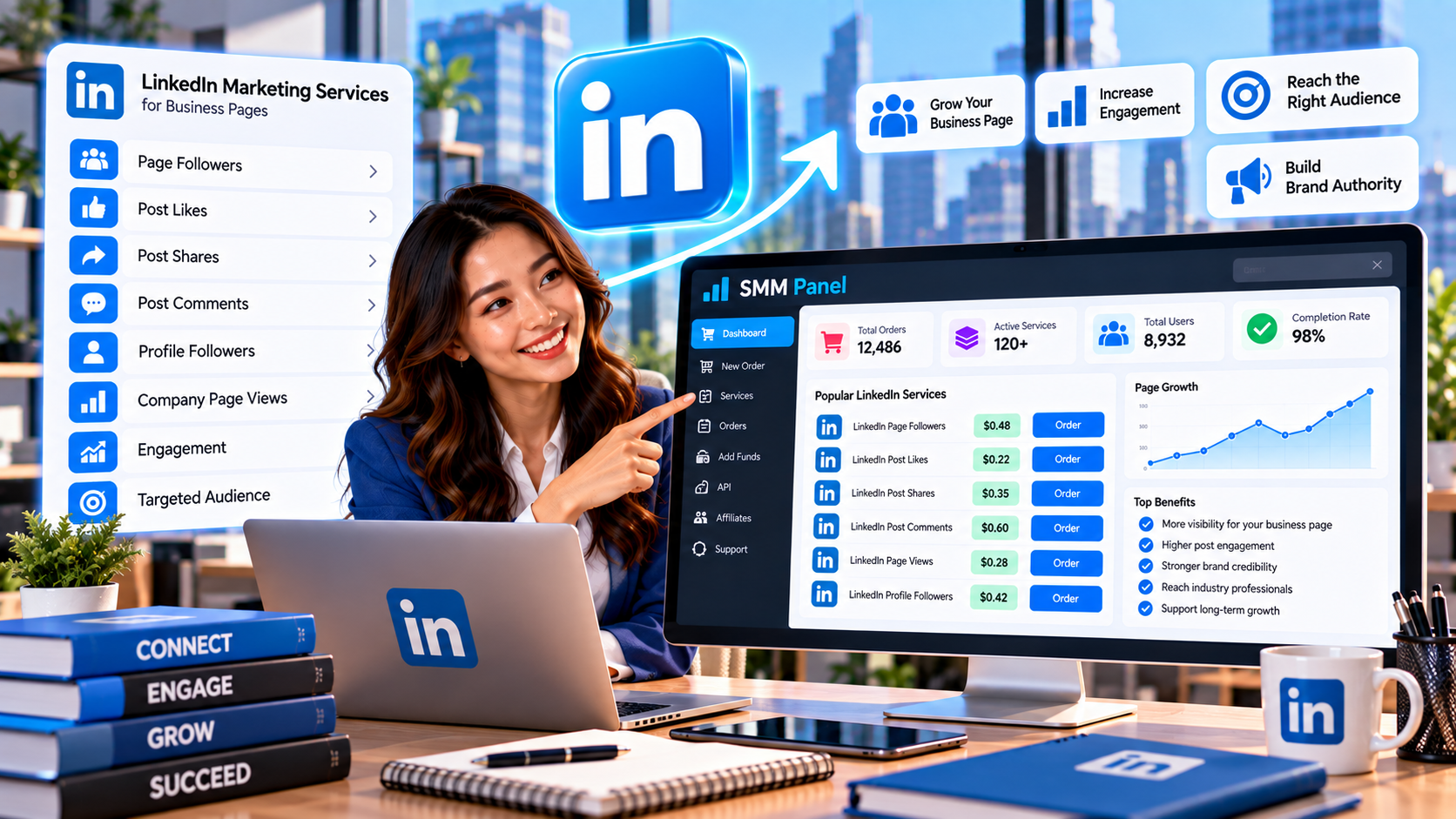
LinkedIn Marketing Services for Business Pages
LinkedIn has become an important platform for businesses that want to build professional visibility, connect with decision-makers, showcase expertise, generate leads, and strengthen their brand reputation.
For many companies, a LinkedIn Business Page is more than an online profile. It can function as a central place for company updates, educational content, product information, hiring communication, industry insights, and customer-facing announcements.
However, simply creating a Page does not guarantee visibility or engagement. Businesses need a consistent content strategy, audience understanding, profile optimization, community interaction, and regular performance analysis.
This is where LinkedIn marketing services can support a broader social media strategy.
Depending on the provider, LinkedIn marketing services may include content planning, Page management, promotional campaigns, audience research, engagement support, analytics, lead-generation activities, and other marketing solutions.
The right approach depends on the company's objectives. A software company may focus on qualified leads, while a professional services firm may prioritize thought leadership and brand awareness.
This guide explains how LinkedIn marketing services can support Business Pages, which activities matter most, how to measure performance, and how businesses can build a more organized LinkedIn marketing workflow.
What Are LinkedIn Marketing Services?
LinkedIn marketing services are professional marketing activities designed to help businesses improve their presence and performance on LinkedIn.
Depending on the agency, platform, or service provider, these services may include:
LinkedIn Business Page management
Content creation and scheduling
Audience research
Engagement management
LinkedIn advertising
Lead-generation campaigns
Company Page optimization
Analytics and reporting
Employee advocacy support
Content promotion
Campaign strategy
Some businesses manage these activities internally, while others work with agencies, freelancers, or specialized marketing platforms.
The objective should always be clear.
A company should know whether it is trying to increase brand awareness, generate leads, drive website traffic, recruit talent, build authority, or support another business goal.
Why LinkedIn Business Pages Matter
A well-managed LinkedIn Business Page can provide a professional destination where potential customers, partners, employees, and other audiences can learn about a company.
LinkedIn's current Page admin tools allow Page administrators to create and manage content and access various analytics and management features. The platform's admin view includes areas for posts, analytics, activity, inbox, and other Page management functions depending on the Page type and admin role.
A Business Page can help a company:
Build Brand Awareness
Regularly publishing useful content can make a company more visible to its professional audience.
Demonstrate Expertise
Educational articles, industry insights, case studies, research, and practical advice can help communicate what the business knows.
Support Lead Generation
LinkedIn can be part of a broader journey from content discovery to website visits, inquiries, forms, and sales conversations.
Strengthen Employer Branding
Businesses can also use their presence to communicate workplace culture, career opportunities, achievements, and company news.
Create a Professional Trust Signal
Prospective customers may visit a company's LinkedIn Page before beginning a conversation. A complete and active Page can provide additional context about the business.
LinkedIn Marketing Services for Different Business Goals
There is no single LinkedIn strategy that fits every company.
Brand Awareness
For awareness campaigns, businesses may focus on impressions, members reached, Page visitors, follower growth, and content engagement.
Lead Generation
A B2B company may prioritize clicks, lead forms, inquiries, qualified prospects, and conversion rates.
Website Traffic
Businesses that depend on content marketing can use LinkedIn to distribute articles, reports, case studies, and educational resources.
Thought Leadership
Consultancies, technology companies, professional service firms, and industry experts can use LinkedIn to explain complex topics in a clear and useful way.
Recruitment
Companies can use their Page and other LinkedIn assets to communicate job opportunities, company culture, employee stories, and career information.
The primary KPI should therefore match the business objective.
How to Optimize a LinkedIn Business Page
Before investing heavily in promotion, businesses should make sure their Page clearly communicates who they are and what they offer.
Company Name
Use the official and recognizable business name.
Logo and Cover Image
Professional branding creates a consistent first impression across the Page.
About Section
Clearly explain:
What the company does
Who it serves
What problem it solves
What makes its offering relevant
How potential customers can contact or learn more
Website and Contact Information
Make it easy for visitors to take the next step.
Industry and Company Information
Complete relevant business details so visitors can understand the company quickly.
Call to Action
LinkedIn provides Page administrators with options for encouraging visitors toward actions such as visiting a website or contacting the business. Some additional Page capabilities are available through Premium Company Page features.
A well-optimized Page should answer a visitor's basic questions quickly:
Who are you?
What do you offer?
Who is it for?
Why should someone care?
What should they do next?
What Should Businesses Post on LinkedIn?
A common problem is creating a Page where every post is promotional.
LinkedIn marketing generally works better when businesses provide useful information alongside promotional messages.
A practical content mix can include:
Educational Content
Explain industry concepts, common problems, useful processes, or practical solutions.
Industry Insights
Discuss relevant market developments, trends, research, and business lessons.
Case Studies
Show how a company solved a customer problem or improved a process.
Product or Service Content
Explain what the company offers and how it helps customers.
Company Updates
Share launches, milestones, partnerships, events, awards, and important announcements.
Employee and Culture Content
Introduce team members, highlight achievements, or show how the organization works.
Customer Stories
Share testimonials, experiences, and case-study material where appropriate and with the necessary permission.
Thought Leadership
Present a clear perspective on an industry topic rather than simply repeating common information.
A balanced content strategy gives people reasons to follow the Page even when they are not currently ready to buy.
LinkedIn Content Formats Businesses Can Use
Different formats can communicate different types of information.
Content formatPotential useText postOpinions, insights, questions, short lessonsImageAnnouncements, statistics, quotes, visual summariesDocumentGuides, reports, checklists, presentationsVideoDemonstrations, interviews, educational contentArticleLong-form thought leadershipPollAudience feedback and discussionNewsletterRecurring educational content where availableEventWebinars, launches, industry sessions
LinkedIn's current Page tools support multiple content and engagement formats, although the exact features available can depend on Page type and access.
The format should support the message rather than being selected simply because it is available.
How LinkedIn Marketing Services Can Improve Content Distribution
Creating high-quality content is only one part of LinkedIn marketing.
Businesses also need to consider how people discover that content.
A useful distribution process is:
Research → Create → Publish → Engage → Promote → Measure → Improve
After publishing a post, the team can monitor reactions, comments, reposts, clicks, and other available performance indicators.
LinkedIn's current Page analytics provide content metrics such as impressions, members reached, clicks, reactions, comments, reposts, and engagement rate.
This information can help businesses understand which topics and formats attract attention.
For example, if practical educational posts consistently generate more relevant clicks than generic announcements, the business can increase the proportion of educational content.
LinkedIn Engagement: More Than Likes
Engagement is useful, but not all interactions represent the same type of business value.
InteractionWhat it may indicateReactionBasic audience responseCommentActive discussion or feedbackRepostContent worth sharing with another audienceClickInterest in learning moreFollowOngoing interest in the companyLeadPotential commercial interest
LinkedIn reports Page engagement rate based on interactions relative to impressions, with interactions including clicks, reactions, comments, and shares or reposts.
Businesses should therefore avoid judging a campaign solely by the number of reactions.
A post that produces fewer reactions but several qualified inquiries may be more commercially useful than a post that generates high-volume lightweight engagement.
LinkedIn Page Analytics for Businesses
Analytics allow businesses to move from assumptions to measurable decisions.
LinkedIn currently provides Page analytics across areas including content, followers, visitors, search appearances, and competitors, with additional analytics available depending on the Page and features used.
Content Analytics
Businesses can review how individual posts perform using metrics such as impressions, members reached, clicks, reactions, comments, reposts, and engagement rate.
Follower Analytics
Follower information can help businesses understand audience characteristics and growth patterns.
Visitor Analytics
Visitor data can help businesses understand who is visiting the Page and how Page traffic changes over time. LinkedIn provides visitor metrics and demographic information such as location, industry, seniority, job function, and company size in the relevant analytics views.
Search Appearance Analytics
Search-related data can help a company understand how discoverable its Page is and what search activity is associated with it.
Competitor Analytics
LinkedIn also provides competitor analytics that can help Page administrators compare follower and organic content metrics with selected competitor Pages.
These features can help a business identify patterns rather than relying on individual post performance.
LinkedIn Marketing Services for B2B Companies
LinkedIn is particularly relevant to many B2B marketing strategies because business purchasing decisions can involve multiple people and longer sales cycles.
A B2B campaign may include:
Educational post → Website article → Lead magnet → Lead form → Sales conversation
For example, a software company might publish:
Industry research
Product tutorials
Customer case studies
Product updates
Security information
Expert commentary
The objective is to demonstrate relevance and expertise before making a direct sales request.
This is why B2B LinkedIn marketing should not be built entirely around promotional posts.
LinkedIn Marketing for Professional Service Businesses
Professional service companies can use LinkedIn content to demonstrate expertise before a prospect ever contacts them.
Examples include:
Accounting firms
Marketing agencies
Consulting companies
Law firms
Recruitment firms
IT service providers
Financial service businesses
Instead of posting only:
“Contact us for our services.”
A firm could create content around:
Common problem → Explanation → Practical advice → Business implication → Optional next step
This approach gives potential customers useful information before they make a purchasing decision.
LinkedIn Marketing Services and Employee Advocacy
Employees can play an important role in extending a company's content beyond the Business Page.
Employees may share company content through their personal professional networks, participate in relevant discussions, or contribute expertise to company publications.
However, employee advocacy works best when participation is authentic.
A company should avoid forcing employees to publish identical promotional messages repeatedly. Instead, provide useful source material that employees can adapt to their own professional voice.
This can help the company reach professional audiences outside its immediate Page following.
LinkedIn Advertising and Sponsored Content
Organic LinkedIn content and paid advertising can work together.
An organic post may help a business identify a topic that receives strong engagement. The company can then consider whether the subject is suitable for a paid campaign.
Paid campaigns can be useful when the objective is clearly defined.
Potential goals can include:
Website traffic
Lead generation
Brand awareness
Event promotion
Product awareness
Recruitment
LinkedIn's Page tools also allow administrators to boost posts, subject to the relevant Page permissions and available features.
Paid promotion should be evaluated through business outcomes rather than impressions alone.
How to Measure LinkedIn Marketing ROI
For businesses, performance reporting should connect LinkedIn activity with broader commercial objectives.
A basic ROI formula is:
ROI = (Return − Investment) ÷ Investment × 100
For example, suppose a company spends $1,000 on LinkedIn content and paid promotion and attributes $3,000 in revenue to that campaign.
ROI = ($3,000 − $1,000) ÷ $1,000 × 100 = 200%
This is an illustrative example.
Actual ROI calculations require a clear attribution method and accurate cost data.
For lead-generation campaigns, companies may also monitor:
Cost per lead = Total campaign cost ÷ Number of leads
However, not every lead has equal value. A campaign producing 20 highly relevant B2B leads may be more useful than one producing 100 poorly matched inquiries.
LinkedIn Marketing Services and Lead Generation
LinkedIn can support different stages of the lead-generation process.
Awareness: Potential customers discover the company.
Interest: They engage with useful content.
Research: They visit the Page or website.
Consideration: They explore products, services, case studies, or resources.
Conversion: They submit a form, request a consultation, start a conversation, or make a purchase.
LinkedIn's current Page analytics can help businesses review visitor, follower, content, and other performance information, while LinkedIn's broader advertising ecosystem offers tools designed for lead-generation campaigns.
Businesses should connect these steps rather than treating a follower count as the final measure of success.
How SMMZY Can Fit Into LinkedIn Marketing
SMMZY can be considered as one component within a broader social media marketing workflow for businesses using LinkedIn.
Businesses should first identify their objective and then review the currently available LinkedIn-related services to determine whether any are appropriate for their specific workflow.
Before using any third-party social media service, review:
The exact service description
Target requirements
Quantity limits
Delivery conditions
Refill terms where applicable
Order-tracking options
Current pricing
For agencies managing several business accounts, keeping provider order information separate from LinkedIn campaign analytics can make reporting more accurate.
For example:
Service metric: Ordered or delivered quantity
LinkedIn metric: Impressions, members reached, clicks, engagement rate, follower growth, or Page visitors
Business metric: Leads, opportunities, customers, or revenue
These metrics should not automatically be treated as equivalent.
The most sustainable LinkedIn strategy should continue to focus on useful content, relevant audience targeting, professional engagement, and measurable business outcomes.
A Practical LinkedIn Marketing Workflow for Business Pages
A business can organize its LinkedIn marketing process into eight steps.
Step 1: Define the Goal
Choose one primary objective for the campaign.
Step 2: Identify the Audience
Understand the industries, job functions, seniority levels, business sizes, and problems that matter to the target audience.
LinkedIn's Page visitor and follower analytics can provide useful demographic context where sufficient data is available.
Step 3: Build Content Pillars
Select a small number of recurring themes such as:
Education
Industry insights
Case studies
Products and services
Company news
Customer stories
Step 4: Create the Content
Adapt the format to the topic instead of posting the same message repeatedly.
Step 5: Publish Consistently
Choose a schedule the team can maintain.
Step 6: Engage
Respond to relevant comments, participate in appropriate conversations, and monitor audience questions.
Step 7: Analyze
Review content, audience, visitor, follower, and search-related data.
Step 8: Improve
Use the data to refine future content and campaign decisions.
The process becomes:
Goal → Audience → Content → Distribution → Engagement → Measurement → Improvement
Common LinkedIn Marketing Mistakes
Posting Only Promotional Content
A Business Page that constantly says “buy now” gives people little reason to follow it.
Ignoring the Target Audience
Content should be written for specific professional audiences rather than for everyone.
Copying Competitors
Competitor research can reveal content gaps, but companies should develop their own perspectives and examples.
Publishing Without a Clear Objective
Every campaign should have a reason for existing.
Focusing Only on Follower Count
Followers provide audience-size information, but clicks, engagement, leads, and business outcomes may be more relevant depending on the goal.
Ignoring Comments
Comments can contain questions, objections, feedback, and future content ideas.
Using Weak Calls to Action
A post should make the desired next step understandable when a CTA is appropriate.
Changing Strategy Too Quickly
One low-performing post does not necessarily mean the entire LinkedIn strategy has failed.
Reporting Vanity Metrics as Business Results
Impressions and reactions are useful, but they should not automatically be presented as sales or revenue.
Frequently Asked Questions
What are LinkedIn marketing services?
LinkedIn marketing services are professional activities designed to help businesses improve their LinkedIn presence through Page management, content creation, advertising, lead generation, audience research, engagement, analytics, and related activities.
Are LinkedIn marketing services useful for Business Pages?
They can help businesses organize and improve different areas of LinkedIn marketing, especially when internal teams do not have the time or expertise to manage every activity themselves.
What should a business post on LinkedIn?
Useful options include educational content, industry insights, case studies, company updates, customer stories, product information, employee content, and thought leadership.
How often should a company post on LinkedIn?
There is no universal frequency that guarantees results. Companies should choose a sustainable schedule based on their available resources and then use performance data to refine it.
Which LinkedIn metrics should businesses track?
Depending on the objective, useful metrics can include impressions, members reached, clicks, engagement rate, follower growth, Page visitors, search appearances, leads, website traffic, and conversions. LinkedIn provides several of these metrics through its Page analytics tools.
Can LinkedIn marketing services generate leads?
LinkedIn can support lead generation through organic content, website traffic, direct conversations, and paid campaigns. Results depend on targeting, offer quality, content, landing pages, sales processes, and other factors.
Is LinkedIn only useful for B2B companies?
No. LinkedIn is particularly relevant to professional and B2B audiences, but companies in many industries can use it for brand communication, recruitment, partnerships, thought leadership, and customer education.
Can I use an SMM panel for LinkedIn marketing?
An SMM panel may offer selected LinkedIn-related services, depending on its current catalog. Businesses should evaluate each service individually and ensure that their overall marketing practices are appropriate for the platform and their objectives.
Does LinkedIn provide Page analytics?
Yes. LinkedIn provides Page analytics covering areas such as content, followers, visitors, search appearances, and competitors, with the available information depending on the Page and applicable features.
Can LinkedIn Page analytics be exported?
LinkedIn currently allows Page administrators to export analytics reports for areas including content, visitors, followers, and competitors, with data available through the Page admin interface.
Final Thoughts
LinkedIn marketing services can help businesses manage and improve their Business Page presence through content, promotion, audience development, engagement, analytics, and lead-generation activities.
The strongest approach begins with a clear business objective. From there, companies can create useful content, optimize their Page, understand their audience, engage professionally, and measure the metrics that actually matter.
LinkedIn provides businesses with a growing set of Page management and analytics tools, including content, follower, visitor, search, and competitor insights.
For companies considering third-party social media services, those services should remain one part of the broader marketing system. They should not replace strong content, professional communication, audience research, or proper performance measurement.
For SMMZY users, reviewing individual service conditions before ordering is an important part of making an informed decision.
Ultimately, a successful LinkedIn Business Page is built by consistently answering one important question:
What useful reason does the audience have to follow, engage with, and remember this business?