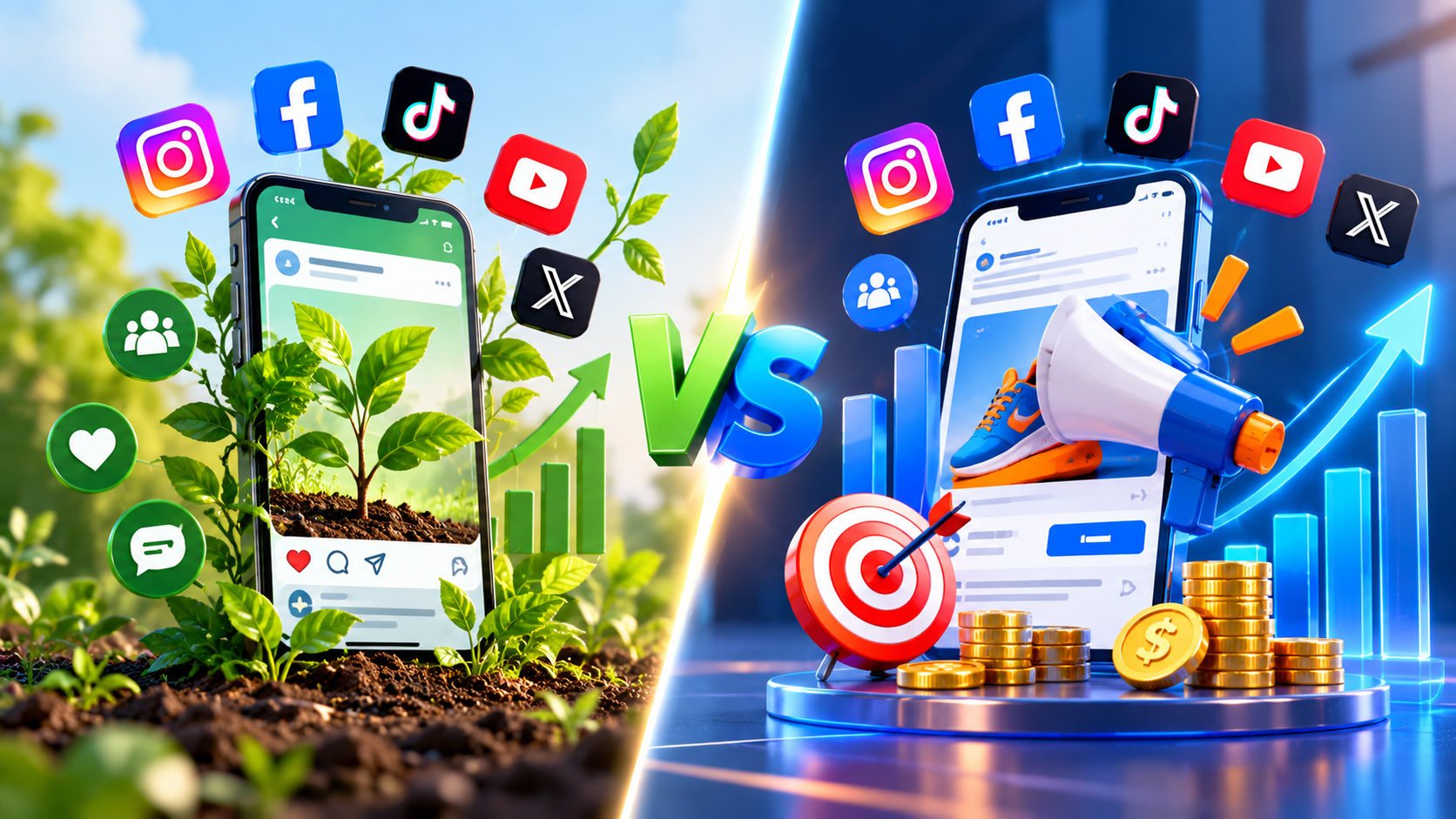
Organic Social Media Growth vs Paid Growth: What’s the Difference?
Social media growth can happen in different ways. Some businesses build their audience gradually through useful content, conversations, shares, and consistent activity. Others use paid advertising to reach a larger audience in a shorter period of time.
This creates an important question for creators, brands, and businesses: Should you focus on organic social media growth, paid growth, or use both?
Organic and paid growth are not necessarily competing strategies. They work differently and can support different marketing goals. Understanding how each method works makes it easier to create a realistic social media strategy instead of expecting one approach to solve everything.
In this guide, we will explain the difference between organic social media growth and paid growth, how each method works, their advantages and limitations, when to use them, and how businesses can combine both approaches effectively.
What Is Organic Social Media Growth?
Organic social media growth refers to audience growth that happens without directly paying a platform to distribute a specific post or profile to users.
Instead, growth comes from activities such as:
Creating useful and interesting content
Posting consistently
Improving content quality
Encouraging conversations
Getting shares and saves
Building relationships with followers
Participating in relevant communities
Using platform features effectively
Creating content that people naturally discover
For example, imagine a small clothing brand regularly posts styling tips, product videos, customer photos, and educational content on Instagram.
One Reel gets shared by several customers and reaches thousands of people. Some viewers visit the profile, follow the account, and eventually become customers.
That is an example of organic growth.
The business did not directly pay Instagram to distribute that particular Reel. Its reach came from audience interaction and the platform's content-discovery systems.
What Is Paid Social Media Growth?
Paid social media growth involves spending money to reach a targeted audience through advertising or other paid promotional methods on social platforms.
Businesses can create campaigns based on objectives such as:
Brand awareness
Website traffic
Video views
Engagement
Lead generation
App installations
Sales or conversions
For example, a local restaurant may create a Facebook and Instagram advertising campaign targeting people within a specific area.
Instead of waiting for its posts to reach local users naturally, the business pays for its content to be shown to a selected audience.
Paid growth can therefore provide more control over who sees a campaign and how much exposure it receives.
Organic vs Paid Growth: The Main Difference
The simplest difference is the way distribution is generated.
Organic growth depends primarily on content, audience interaction, discovery, and consistency. Paid growth uses advertising budget to purchase additional exposure or targeted distribution.
FactorOrganic GrowthPaid GrowthMain driverContent and engagementAdvertising budgetCostUsually lower direct distribution costRequires advertising budgetSpeedUsually gradualCan generate exposure quicklyAudience targetingMore limitedMore controllableLong-term valueCan continue through content discoveryUsually depends on active campaignsTestingContent-based experimentationCampaign-based testingRelationship buildingStrong focusCan support relationship buildingScalabilityDepends on content performanceBudget can increase campaign reachBest forLong-term audience developmentTargeted campaigns and faster exposure
Neither method automatically produces better results in every situation. The right choice depends on the business goal, audience, content quality, budget, and stage of growth.
How Organic Social Media Growth Works
Organic growth usually develops through several connected activities.
1. Creating Valuable Content
People need a reason to stop scrolling.
Educational posts, entertaining videos, useful tutorials, behind-the-scenes content, customer stories, and industry insights can all give people reasons to interact with an account.
The goal should not simply be to publish more content. The goal is to publish content that is relevant to the intended audience.
2. Understanding the Audience
Organic growth becomes easier when a business understands who it is trying to reach.
A fitness brand, for example, may create completely different content for professional athletes than for beginners who are just starting to exercise.
Audience research can influence:
Content topics
Language
Visual style
Posting format
Video length
Calls to action
Platform selection
3. Encouraging Engagement
Comments, shares, saves, replies, and other interactions can help content generate additional activity.
However, engagement should be treated as a communication opportunity rather than simply a number.
When someone leaves a useful comment, replying thoughtfully can turn a single interaction into the beginning of a relationship.
4. Maintaining Consistency
One successful post can attract attention, but a consistent publishing system gives an account more opportunities to reach people.
Consistency does not necessarily mean posting several times every day.
A realistic schedule that a business can maintain is generally more useful than an aggressive schedule that becomes difficult to continue.
5. Learning From Performance
Organic growth should also be measured.
A business can examine which posts receive more:
Reach
Shares
Saves
Comments
Profile visits
Follows
Website clicks
These patterns can help improve future content.
How Paid Social Media Growth Works
Paid growth follows a different process.
Step 1: Define the Campaign Goal
Before spending money, a business should determine what it wants the campaign to accomplish.
For example:
Goal: Generate website traffic
This is different from:
Goal: Increase video awareness among a new audience.
The campaign objective affects the audience, creative, optimization, and measurement approach.
Step 2: Select the Audience
Paid platforms generally provide targeting options that can help advertisers reach specific groups.
Depending on the platform and campaign, targeting can involve factors such as:
Location
Demographics
Interests
Behaviors
Existing audiences
Website visitors
Customer lists
Targeting should be based on the actual customer profile rather than simply choosing the largest possible audience.
Step 3: Create the Advertisement
The advertisement may include:
Video
Image
Carousel
Text
Product information
Call-to-action button
Creative quality remains important even when a campaign has a large budget.
Paying for distribution does not automatically make weak content effective.
Step 4: Monitor the Campaign
Once a campaign starts, marketers can review performance and make adjustments.
Common metrics include:
Impressions
Reach
Click-through rate
Cost per click
Video views
Leads
Conversions
Cost per conversion
The exact metrics that matter depend on the campaign objective.
Advantages of Organic Social Media Growth
Organic growth has several important benefits.
Builds Long-Term Audience Relationships
Organic content creates opportunities for repeated interaction between a brand and its audience.
People can discover a business through useful content and continue following it because they find the account valuable.
Reduces Dependence on Advertising
A business with a strong organic presence does not have to rely entirely on paid advertising for visibility.
Its existing content library can continue attracting attention through search, recommendations, shares, and other discovery methods.
Supports Brand Personality
Organic content gives businesses more freedom to show their personality.
Behind-the-scenes videos, employee stories, customer experiences, educational posts, and community discussions can make a brand feel more recognizable and human.
Creates Compounding Content Value
A useful post can continue receiving views and interactions after publication.
Not every post will have a long lifespan, but evergreen content can continue contributing to an account over time.
Limitations of Organic Growth
Organic growth also has challenges.
It Can Be Slow
A new account may take time to develop an audience.
There is no guaranteed number of followers or views that a business will receive from posting consistently.
Results Can Be Unpredictable
One post may perform extremely well while another similar post receives limited reach.
Platform recommendation systems, audience behavior, topic demand, competition, and content quality can all influence performance.
Requires Consistent Work
Organic growth usually requires ongoing effort in:
Content creation
Research
Community management
Analytics
Testing
Strategy
For small teams, maintaining this process can be challenging.
Advantages of Paid Social Media Growth
Paid campaigns offer a different set of benefits.
Faster Exposure
Paid advertising can put content in front of a selected audience without waiting for organic discovery.
This can be particularly useful when launching a product, event, promotion, or new business.
More Audience Control
Advertisers can often define specific audience characteristics and campaign conditions.
This makes paid promotion useful when a business wants to reach a particular market rather than relying entirely on organic discovery.
Easier Campaign Testing
Paid campaigns can provide structured ways to test different:
Creatives
Audiences
Messages
Offers
Landing pages
The results can then inform future marketing decisions.
Useful for Specific Business Goals
Paid advertising can be especially useful when a campaign has a clearly defined objective, such as generating leads or driving traffic to a product page.
Limitations of Paid Growth
Paid growth also has limitations that businesses should understand.
It Requires Continuous Budget
When an advertising campaign stops spending, its paid distribution generally stops as well.
This makes paid traffic different from organic content that may continue receiving exposure after publication.
Poor Targeting Can Waste Money
A large advertising budget does not guarantee useful results.
If the audience, offer, creative, or landing page is poorly matched, the campaign may generate exposure without producing meaningful business outcomes.
Advertising Does Not Replace Trust
People may see an advertisement without knowing or trusting the brand.
That is why businesses often benefit from maintaining a strong organic presence alongside paid campaigns.
Organic Growth vs Paid Growth: Which Should a Business Use?
This depends on the goal.
A business focused on long-term brand development may place more emphasis on organic content.
A business launching a time-sensitive campaign may find paid advertising useful for reaching a selected audience quickly.
A growing business may use both.
For example, consider a new online clothing store.
Its organic strategy could include:
Styling tutorials
Product education
Customer-generated content
Behind-the-scenes videos
Fashion tips
Its paid strategy could promote:
Best-selling products
Seasonal offers
New collections
Retargeting campaigns
The two systems work together rather than operating separately.
Can Organic and Paid Growth Work Together?
Yes.
In many cases, combining both approaches creates a more complete social media strategy.
A simple workflow could look like this:
Organic content → Identify strong content → Promote selected content → Reach a wider audience → Bring people to the profile or website → Build relationships through ongoing content
Suppose a business publishes ten videos during a month.
Two videos receive significantly stronger engagement than the others.
Instead of putting advertising budget behind every video, the business could analyze why those two pieces performed well and consider using paid promotion for an appropriate campaign objective.
This creates a feedback loop between organic content and paid marketing.
Organic vs Paid Growth for Small Businesses
Small businesses often have limited time and budget, so prioritization matters.
A practical approach is to establish a basic organic foundation first.
That can include:
Completing the social profile
Defining the target audience
Creating useful content
Establishing a realistic posting schedule
Tracking basic performance metrics
Testing paid campaigns when there is a clear objective
This approach allows the business to build its public presence while using paid advertising selectively.
A small business does not necessarily need a huge advertising budget to begin testing paid campaigns. What matters more is having a clear goal and measuring what happens after the campaign starts.
Organic vs Paid Growth for New Accounts
New accounts face a different challenge because they have little existing audience data.
Organic content can help determine:
Which topics attract attention
Which formats work
Which audience responds
Which messages generate interaction
Paid campaigns can then be used for specific acquisition or awareness goals.
Instead of assuming that every piece of content will work, new accounts can use early performance data to refine their strategy.
What About SMM Panels?
SMM panels are sometimes used as part of broader social media marketing workflows, but they should not be confused with paid advertising on platforms such as Meta, TikTok, or other social networks.
An SMM panel typically provides social media marketing services through a centralized dashboard.
Depending on the provider, services may include:
Followers
Likes
Views
Comments
Shares
Subscribers
Other social engagement services
These services are different from purchasing official advertising placements from a social media platform.
Businesses should therefore understand exactly what type of service they are purchasing and what outcome it is intended to support.
For long-term brand development, an SMM panel should not be treated as a replacement for content strategy, audience research, community building, or official advertising.
Common Mistakes When Choosing Between Organic and Paid Growth
Mistake 1: Expecting Organic Growth to Happen Immediately
Publishing a few posts does not necessarily produce a large audience.
Organic growth generally requires testing, consistency, and time.
Mistake 2: Believing Paid Advertising Guarantees Sales
Paid advertising creates opportunities for exposure and action, but the final result can depend on the offer, audience, creative, website, pricing, and customer experience.
Mistake 3: Spending Without a Clear Goal
Advertising without knowing what success looks like makes campaign evaluation difficult.
Mistake 4: Ignoring Organic Content After Starting Ads
A person who discovers a business through an advertisement may visit its profile.
If the profile contains outdated or weak content, the advertising campaign may lose some of its potential value.
Mistake 5: Measuring the Wrong Metric
A campaign designed for website conversions should not be judged only by impressions.
Similarly, an awareness campaign should not necessarily be evaluated using the same criteria as a sales campaign.
The metric should match the objective.
A Simple Social Media Growth Strategy
Businesses that are unsure where to begin can use this basic framework.
Phase 1: Build the Foundation
Create complete profiles and establish clear branding across relevant platforms.
Phase 2: Publish Organic Content
Create useful, educational, entertaining, and promotional content based on audience needs.
Phase 3: Measure Performance
Track reach, engagement, profile activity, traffic, leads, or other relevant metrics.
Phase 4: Identify Patterns
Look for topics and formats that consistently perform well.
Phase 5: Test Paid Promotion
Use paid campaigns when there is a clear business reason to reach a larger or more targeted audience.
Phase 6: Improve the System
Continue testing content, audiences, offers, and campaigns based on actual performance data.
This creates a repeatable marketing process instead of relying on random posting or random advertising.
Frequently Asked Questions
Is organic social media growth free?
Organic growth does not require paying a platform for every impression, but it is not necessarily completely free. Businesses may spend money on content creation, employees, design, software, photography, video production, or other resources.
Is paid social media growth faster than organic growth?
Paid campaigns can generate exposure more quickly because advertisers can purchase targeted distribution. However, speed of exposure does not automatically mean faster business growth or better results.
Is organic growth better for long-term branding?
Organic content can be useful for long-term branding because it allows businesses to continuously educate, communicate with, and build relationships with their audience. The results depend on content quality, consistency, audience fit, and many other factors.
Should a small business use paid advertising?
A small business can consider paid advertising when it has a clear objective, defined audience, suitable creative, and a budget it can afford to test. It should measure results rather than assuming that spending automatically produces success.
Can a business use organic and paid growth together?
Yes. Organic content can build a content foundation and audience relationship, while paid campaigns can provide targeted distribution for specific marketing objectives.
Does having more followers guarantee social media success?
No. Follower count is only one metric. Reach, engagement, website traffic, leads, conversions, customer relationships, and revenue may be more relevant depending on the business objective.
How should a business decide how much to spend on paid social media?
There is no universal budget that works for every business. The appropriate amount depends on factors such as campaign objectives, audience size, customer value, available resources, and previous campaign performance.
Final Thoughts
Organic social media growth and paid growth serve different purposes.
Organic growth focuses on building an audience through content, engagement, consistency, and relationships. Paid growth uses advertising budget to reach selected audiences and support specific campaign objectives.
The two approaches do not have to be treated as opposites.
A strong social media strategy can use organic content to establish credibility and understand the audience, while paid campaigns can provide additional reach when there is a clear reason to invest in advertising.
The most important step is not simply choosing between organic and paid growth. It is understanding what the business is trying to achieve, who it wants to reach, which metrics matter, and which activities can realistically support those goals.
When social media growth is treated as an ongoing system rather than a race for numbers, businesses can make more informed decisions about content, advertising, engagement, and audience development.